_14297_34265589.png)


Mutual Housing expands
award-winning community
in Woodland with 39 new
Positive Net Energy homes
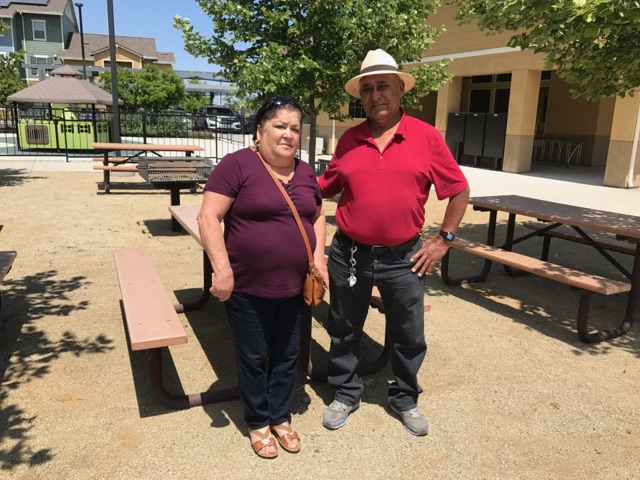
Since they moved to California some 20 years ago to harvest the food that America eats, the one constant in the lives of Jose and Alicia Guzman has been the underlying stress of their housing instability.
At the migrant labor camp in rural Yolo County, they always knew that once the harvesting was done, the place would shut down and they’d have to leave. Then they would move into a son or daughter’s trailer or apartment, where they felt like they were a burden, taking up space in their family members’ living rooms.
Always, the anxiety. Always, the stress. Always, the instability. And this was even before Jose Guzman, who is now 71, was diagnosed with prostate cancer, and before he blew out his knees when he had to kneel on the ground to pick peppers and wade in thigh-high mud to lay irrigation lines.
“Our nerves would be really bad,” Alicia, 67, said in a recent interview. “We didn’t know what we were going to do.”
Cramped in a trailer near the Yolo County Fairgrounds, Jose and Alicia Guzman learned about this relatively new community in Woodland that had been built for farmworkers like themselves. It was called Mutual Housing at Spring Lake. When they visited the sparkling new 62 townhomes and apartments, Jose and Alicia found out that even their fellow farmworkers whose average wage in Yolo County was $12 an hour could afford to live there.
Although all of the homes were occupied, Jose and Alicia put their names on a waiting list – and their timing could not have been better. Last year, the nonprofit Mutual Housing California began construction on a 39-home second phase to the Spring Lake community and was taking applications. Earlier this year, Jose and Alicia learned that they had won something almost as good as the lottery: they had been selected for residency at the new Mutual Housing at Spring Lake Phase II.
In May, the couple moved into their new home, complete with donated bedroom and dining sets, and they felt the effects almost immediately.
“Somos mas tranquilos – we are calmer,” Jose Guzman said, in the interview held in the Mutual Housing community room at Spring Lake.
“We just want to rest and enjoy our home,” he said, through the translation provided by Mutual Housing community organizer Miriam Vazquez Tapia. “When we were living with other people, we felt a little bit uncomfortable. Now we don’t have to worry about bothering anyone.”
On June 13, Mutual Housing will unveil Spring Lake II in an opening ceremony at the community property on Farmers Central Road in Woodland. With the Guzmans and members of some of the 38 other farmworker families on hand, the opening will mark the 20th addition to Mutual Housing’s portfolio of communities in Sacramento and Yolo counties. Altogether, they house more than 3,100 people in some 1,110 apartments, townhouses and mobile homes, at rents that are well below the market rates for the surrounding areas.
The two phases of the Mutual Housing farmworker community in Woodland are located in the middle of the expansive new Spring Lake residential area on the city’s southern fringe where homes sell for $400,000 and up. Between the two phases of Mutual Housing at Spring Lake, the city of Woodland contributed $2.5 million in funding to help house the cost-burdened low-wage workers who are crucial to the success of Yolo County’s $635 million agricultural industry.
“We are proud not only to have this housing for our farm workers, but to have this housing of tremendous quality, beautifully designed and well operated,” Woodland City Council member Tom Stallard said. “Woodland is a farm community – we have 185 ag-related businesses, not all of them working in the fields, but also in food processing and the like, and this just makes it a little easier for farm workers to have the kind of housing we want everybody to have. It’s not being hidden off to the side. It’s right out there, and we look forward to having more such inclusionary housing to benefit those in economic need.”
The opening of Spring Lake II comes a little more than four years after Mutual Housing’s revolutionary rollout of the community’s initial phase in February 2015. Revolutionary, because when it opened, Spring Lake I became the first federally-certified Zero Net Energy rental housing development in the United States. Through solar installations and energy-efficient designs and building systems, ZNE means that over the course of a year, the solar system at Spring Lake is designed to produce as much energy as the residents are expected to consume. The certification, in essence, amounted to a win-win shaded in green – the obvious environmental benefit, plus a huge financial boon for Mutual Housing’s low-income residents who can keep more money in their pockets through the huge reductions on their utility bills.
Spring Lake I literally caught the world’s attention. First, the U.S. Department of Energy recognized it with a 2015 Housing Innovation Award for energy efficiency in the category of multifamily homes. Then, the United Kingdom-based World Habitat organization, one of the international community’s most distinguished charities – in conjunction with UN-Habitat, the United Nations’ program for human settlements – honored Mutual Housing at Spring Lake by designating it for the prestigious 2017 World Habitat Award. It was only the eighth such honor given out to a U.S. recipient since the award was created in 1985.
Now, with Spring Lake II, Mutual Housing is positioned to improve on its achievement. The new development is projected to not only zero out its energy usage, but to even produce more than it takes in and pump it back into the electric grid. The result will be a 105 percent Positive Net Energy community, and that is just fine with Jose Guzman, too.
“I’m the type of person who likes to save water and conserve electricity,” he said. “I like that idea. The best that we can do, we will do.”
In each of the Mutual Housing communities, it is the very concept of community that makes them not just safe and affordable, but also: a home, a neighborhood, a place of interaction and celebration, where people learn about civic engagement, how to organize, how to have a voice in the direction of their schools, their police departments, the policies of their city councils and their county supervisors.
Perhaps nowhere in the Mutual Housing landscape is the idea of community more tangible than it is in Spring Lake I and as it is likely to be in the adjunct of Spring Lake II, which is located right across the barbecue pits and children’s play grounds that join the still-shiny buildings opened in 2015 with the even newer ones completed here in 2019.
“We are community building, and we are in this case building amongst a specific population which has had a lack of access to high-quality housing they can afford and that has very often experienced disruptions in its own ability to be a community,” said Mutual Housing California CEO Roberto Jimenez. “What residents of these properties say is, ‘I now have a community. I have people who I am comfortable with.’ And that’s what we’re looking for.”
The 101 units in the two phases of Mutual Housing at Spring Lake cost a combined $38.1 million. Along with the City of Woodland’s contribution, Wells Fargo Bank syndicated $23.9 million in state and federal low-income housing tax credits to account for the bulk of the financing. The United States Department of Agriculture provided $8.5 million in loans. Citibank, the state’s Joe Serna Jr. Farmworker Grant Program and the California Community Reinvestment Corporation provided the balance of the loans, with Citibank and Wells Fargo handling the construction loans.
In the development of Spring Lake II, the same as Spring Lake I, Mutual Housing reached out again to one of its most trusted partners when it retained as its general contractor Sunseri Construction of Chico. A dozen times over more than two decades, Sunseri has worked with Mutual Housing to build or rehabilitate communities from Davis to south Sacramento to North Highlands.
It’s easy to see why the relationship has blossomed: both Sunseri and Mutual Housing have made it the life work of their companies to build, promote and preserve the idea as well as the need for nonprofit affordable housing development.
Sunseri President Don Lieberman views the development of affordable housing as nothing less than a matter of social justice.
“My focus is on the unbelievable and unacceptable need for stable, affordable housing in California – the hundreds of thousands of units that need to be built – and how we’re going to make this process efficient and streamlined and get the NIMBY factor out of it, and get the Legislature to not only continue to provide funding sources that they’ve been doing, but to get them to streamline the process so we can get units built quickly,” Lieberman said.
Sunseri is a for-profit general contractor, but when it comes to building affordable housing, it works strictly with nonprofits. And when it comes to nonprofits, Lieberman regards Mutual Housing as one of the best.
“Basically, Mutual sticks out because of the indelible connections they create with the residents,” Lieberman said. “All the nonprofit affordable housing developers strive to lift up people’s lives through stable housing environments. I believe Mutual Housing succeeds in going many steps beyond that, by literally forming resident communities and empowering the individuals in those communities, and by bringing those individuals into the heartbeat of Mutual Housing, through board (of directors) service, as well as through its community service.”
Creation of a community – giving social justice a place to incubate – begins with design. At Spring Lake II, Phil Harvey of Kuchman Architects looked for something that would evolve directly from the success of and connect to Spring Lake I, through its common outdoor spaces and community rooms, and adding more such amenities like the barbecue pits and tetherball courts, to tighten the linkage.
“We wanted to make it have the same sort of feel but kind of take it a step further,” Harvey said. “There are two-story buildings – Phase One had a three-story building, so this one is a little more residential in scale. We tried to put out a feeling of warmth and home-ness, so that it’s not cold, so it’s not like a big, block-long project. It’s still a lot of units, but we tried to break them up into two distinct sections so it would look like a large house or have that sort of feeling, with balconies and outdoor spaces in each unit. So I really was trying to create, along with a sense of community, a sense of a home that fit with that area, that fit with Phase One and the single-family homes that surround there. To give them a feeling that this is their home.”
To achieve the 5 percent-plus energy production, Mutual Housing brought in its previous energy consultant, Sean Armstrong of Redwood Energy, to improve on the energy efficiency measures from Phase One. For one thing, tenants will get their water twice as fast with skinnier piping. They’ll also be using water heaters that are almost twice as efficient as the ones from four years ago. The new LED lighting uses half the energy of the old. The newer design added a few tweaks here and there, like making sure that the photo sensors that turn the exterior lights on and off were not located in the shade.
“Mutual Housing is my greenest client,” Armstrong said. “They’re uncommonly good at empowering the tenants to understand what’s going on. Phase Two is going to be even more worthy of an award than the first one. It’s going to be the same development, but better.”
More water will be saved in the second phase, thanks to a “grey water” recapturing system where 80,000 additional gallons a year will be recycled out of the laundry room into underground storage tanks for reuse in landscaping.
“When you get into some of the outlying counties outside the Bay Area, grey water systems are pretty unusual to see,” said John Russell, founder and CEO of WaterSprout, Inc., of Oakland, a subcontractor on Spring Lake II. “We’re always excited to be part of those types of projects with a strong sensibility when it comes to sustainability.”
For solar installation, Mutual Housing selected a nonprofit out of Oakland that also has social justice in mind. The company, Grid Alternatives, came into being during California’s 2000-01 energy crisis, born out of an impulse by its founders to come up with something to help low-income people who were disproportionately harmed by the skyrocketing electricity costs.
“We were founded by mechanical engineers who were basically inspired to use this technology to provide an economic benefit to people who were most vulnerable to poverty and pollution, and, now that we think about it, will be most impacted and are most at risk with climate change,” said Grid Alternatives Deputy Director Rebekah Casey.
Mutual Housing enjoyed a side benefit from its relationship with Grid Alternatives: the company with thousands of projects in its portfolio also has an apprenticeship program. It fulfilled its self-imposed local-hire goals on Spring Lake II by bringing a Mutual Housing resident into its paid training program.
“We pay the local hire and put them through a basic training curriculum,” Casey said. “In addition to working on the roof, our trainee was in the classroom learning about the basic principles of electricity and design, and also going out on other low-income projects and helping us install there, and do the design.”
The bottom line for everything at Mutual Housing is the idea of community. It takes shape in the construction, in the design, and in the support programs that Mutual Housing puts out for residents at the two Spring Lakes and at all its communities, to help them understand finance and credit, to bring them into the digital world, to prepare them for college, to bring out their artistic impulse.
Roberto Jimenez, the Mutual Housing CEO, sees the yearning for community most acutely in the eyes of the farmworkers. He sees that they want to interact with each other, to develop relationships with local officials, to engage in civic life, to communicate with their grower bosses, to celebrate their own culture.
“They lived on the outskirts,” he said of farmworkers. “They’ve lived in substandard housing. They’ve lived on farms. They’ve lived in their cars. They’ve been homeless. They’ve not had access to grocery stores, to schools, and health care, and libraries, and all the other things that everybody else in the community enjoys. When they don’t have access to their communities, it’s really hard for them to be civically engaged. All they want is to participate in the life of their community. When they can, it is a cause for celebration.”
Jose and Alicia Guzman will join in the celebration. In time, they’ll become friends with their new neighbors. They’ll join in the Mutual Housing community gatherings. For now, in their first days in their new home, in their new community, they are content to walk the grounds. They grow calmer with each step, and with each deep and easy breath they take. They are ecstatic.
“We wanted peace,” Jose Guzman said. “We wanted tranquility. And we think we’ve found it here.”

Click here to learn more about their low-income assistance programs.