_14297_34265589.png)


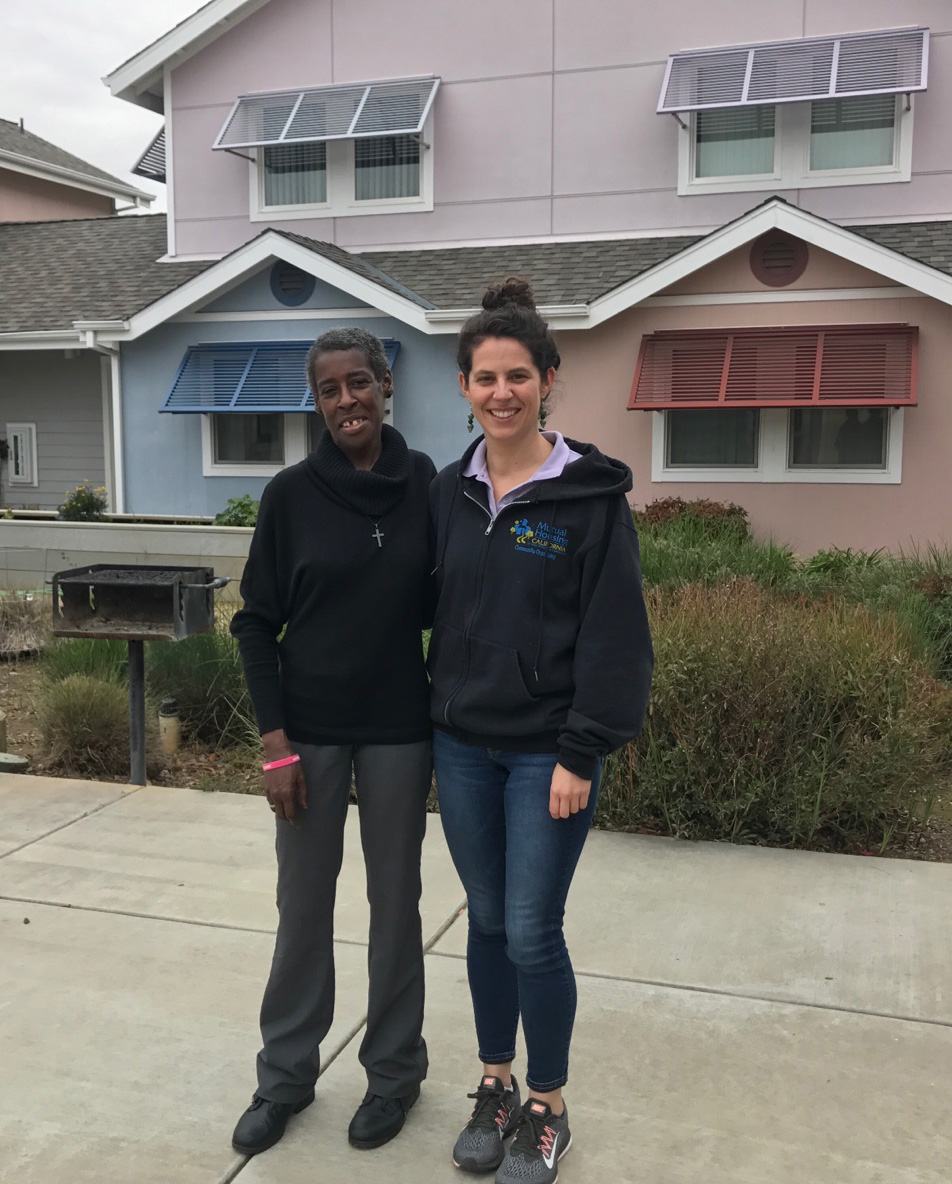
Julia Chandler bore so much pain.
Abandoned on the streets at age 15, her destitution led to prostitution. She gave birth to a son who had a stroke when he was six months old and who never walked or spoke and who died young. Then came the drug use and the eventual addiction, and a chronic homelessness that lasted more than a decade.
Four years ago, Julia, who is now 58, caught a break. She found out about Mutual Housing California, and was able to qualify for her own apartment. Two weeks later, in August 2015, her approval came in, and she moved into Mutual Housing at the Highlands.
Julia didn’t know it at the time, but her ability to stabilize her housing situation would ultimately play a huge role in saving her life.
Early last year, Julia felt a lump on the side of her neck. Then another one, and another one.
“I mean they got big, too,” Julia said. “They kept getting bigger and bigger, and it kept hurting.”
She went to the emergency room at Mercy General Hospital last April, to see what was going on. The news was about as bad as it gets.
“The lady came back – I was sitting out in the hallway – and she says, ‘I have something to tell you. You want to talk here?’” Julia recalled. “And I said you can go on and tell me, and she says, ‘You have cancer.’”
As devastating as it was, the lymphoma diagnosis did not mean the end of the story for Julia Chandler. The fighting spirit she brought to the battle helped her get the upper hand over the disease earlier this year, when doctors declared that after a series of chemotherapy treatments, her cancer had gone into remission.
Along with her positive attitude, there was another huge reason behind Julia’s success on the cancer front:
She had a place to live.
In her previous status as a person who repeatedly experienced housing instability and homelessness, there was a good chance that the cancer diagnosis for Julia would have meant a death sentence.
She, for one, does not think she would have been able to survive if she had been homeless at the time the cancer struck.
“No,” Julia said. “I would have gave up.”
The correlation between homelessness and bad health outcomes has been well documented.
To live on the streets, to be dangerously exposed to the elements of the outdoors, means you’re three to six times more likely to get sick, four times more likely to wind up in the hospital, and that the chances are good that you will die between the ages of 42 and 52. Even if you manage to wind up in a shelter, your living conditions are a good bet to be overcrowded, sometimes not the most sanitary, and likely to increase your exposure to illness. You won’t eat or sleep well. You will be subjected to a higher risk of violence.
The tab on your Medicaid will cost society about 12 percent more than if you had your own place to stay. Your access to health care will be compromised, and when you do need medical services, odds are greater that you’ll get them in an emergency room. And even with your hospital stays, your mortality rate will still be three times the average of the general population.
Then there is being homeless and having cancer. It takes the illness to a whole different level. Cancer death rates for people experiencing homelessness are twice those of the average adult population. Behind drug overdoses, it is the second-leading cause of death among members of the homeless population, and it is the number one killer of unsheltered people between the ages of 45 and 64.
Along with the statistics, there is the issue of palliative care: it’s fairly non-existent for the homeless, with many people spending their final hours alone, exposed, and in horrible pain.
“I don’t think if I didn’t have a roof over my head, I would have been so apt, or been so eager, to go through the treatment, to do everything I had to do, to be here and there and there,” Julia said. “I don’t think I would have did it.”
Born on the Army base in Fort Lewis, Wash., the daughter of a career soldier, Julia’s mother and father separated early in her life and she lived with her dad who transferred to different outposts all over the world. When she was 15, she went to live with her mother in Sacramento.
“We didn’t get along very well, so I didn’t stay with her long,” Julia said. “Since then, I’ve been on my own.”
She was 15-years-old – unwanted, alone, and selling herself to survive.
A pregnancy at age 19 forced a life change. Julia kept her daughter and pulled herself off the streets. She had her son about a year later, who, after his stroke, was diagnosed with cerebral palsy. For the next two decades she mixed minimum-wage jobs with public assistance and brought in enough income to keep a roof over everybody’s heads.
Then, in 2002, her son died, at age 22.
“After the stroke, he couldn’t do anything,” Julia said of her son, TyShawn McDonald. “The doctors told me he would never walk or talk. I thought he’d be able to, and I told him, ‘You’re going to be able to say something to me one day.’ He never did. But I’m a positive person, and no matter what, I have to get some positivity out of it. Waking up every morning and he’s still there was something for me to look forward to.”
When TyShawn was gone, the pain returned to Julia’s life with a vengeance.
“And I started using again,” she said. “I lost a big part of me. He was the something I look forward to, and he’s not here no more.”
Crack cocaine bit into Julie, and she went back to what she knew – prostitution – to finance her habit. She bounced back and forth between Sacramento and Merced, as well as between sobriety and relapse. She went to junior college. She moved in for a while with her daughter. She relapsed again, and she bounced around from one friend’s living room to another.
About four years ago, Julia made her way to Women’s Empowerment, a counseling, career-mentoring, and support program for homeless women with an office near the Loaves and Fishes complex north of downtown Sacramento.
“I went through their program,” Julia said, “and they helped me get in here,” into Mutual Housing at the Highlands, which operates under the “housing first” model where 98 percent of the people who have engaged in it across the country have stayed off the streets.
Of the 19 properties in the Mutual Housing portfolio, “the Highlands” is one of the most unique. Funded in part with nearly $3 million from the Proposition 63 Mental Health Services Act, more than a third of the 90 homes in the North Highlands community are reserved for people who had been homeless and who had mental illnesses that were not being treated.
“The first day I be here, somebody was outside, acting crazy,” Julia recalled. “I’m thinking, ‘What you got me into here? I’m going into my house and not coming outside.’ But then you get to know people.”
When the cancer came last year, when she began her chemotherapy treatments, the nausea, the weakness, the hair loss – it all kept Julia from wanting to do much of anything. At her weakest, she wouldn’t leave her apartment – wouldn’t even answer a knock at the door.
If Julia may have isolated herself from her neighbors in her first days at the Highlands, it was one of the case workers for on-site provider Lutheran Social Services who helped draw her out of her apartment.
The case manager, Chris Grabe, “checked on me, called me, got to my daughter and said you better come check on your mama when she hadn’t seen me for a couple of days,” Julia said. Grabe and other LSS staffers drove Julia to her chemo treatments at Kaiser Roseville and handled other tasks for her.
The helping hands helped change her mindset.
“She was positive throughout all of it,” said Zach Kihm, her new LSS case manager. “It didn’t seem like it was ever a burden for her. And when it was over, she just went back to being herself.”
By January, Julia’s cancer had gone into remission.
In the weeks since then, she has slowly built her strength up, to where she is now planning out a women’s self-esteem class that she had begun to conceptualize before she became ill.
“Julia is the one who put it all together,” said Courtney Poole, the community organizer at the Highlands. “She did her own research, from her life experience, that she wanted to share. She’s prepared, with all the folders, for everyone. Julia has just continued to prepare and be ready.”
The idea of the program, Julia says, is to “encourage the ladies here. Trying to get them out. Just because you’re here doesn’t mean you have to be down in the dumps all the time. What I’m encouraging them to do is to not do what I did. I started isolating. Staying to myself. Not communicating with people.”
Day by day, Julia keeps getting stronger, healthier. She gets out of her room. She’ll talk you up, and she’ll work to pull you out of it if you fall into a funk.
She has taken up crochet. She’s found a new church. She’s very solid in her relationship with her daughter who also helped drive her to her chemo treatments, and also with her granddaughter, and a male friend she describes as “a significant other” who helped her through the cancer ordeal.
Her new LSS case worker notices a perpetual smile on her face.
“When someone has housing and security and feels safe, they’re much more able to actualize themselves,” Zach Kihm said. “They’re much more able to prosper. Julia has taken advantage of this opportunity, and she’s used it in a way that has allowed her to grow and to get over her health issues. That’s the point of providing housing, to build a person up.”
And, in Julia Chandler’s case, to keep her alive.
“I have no reason to be down no more,” Julia said. “I got life.”