_14297_34265589.png)


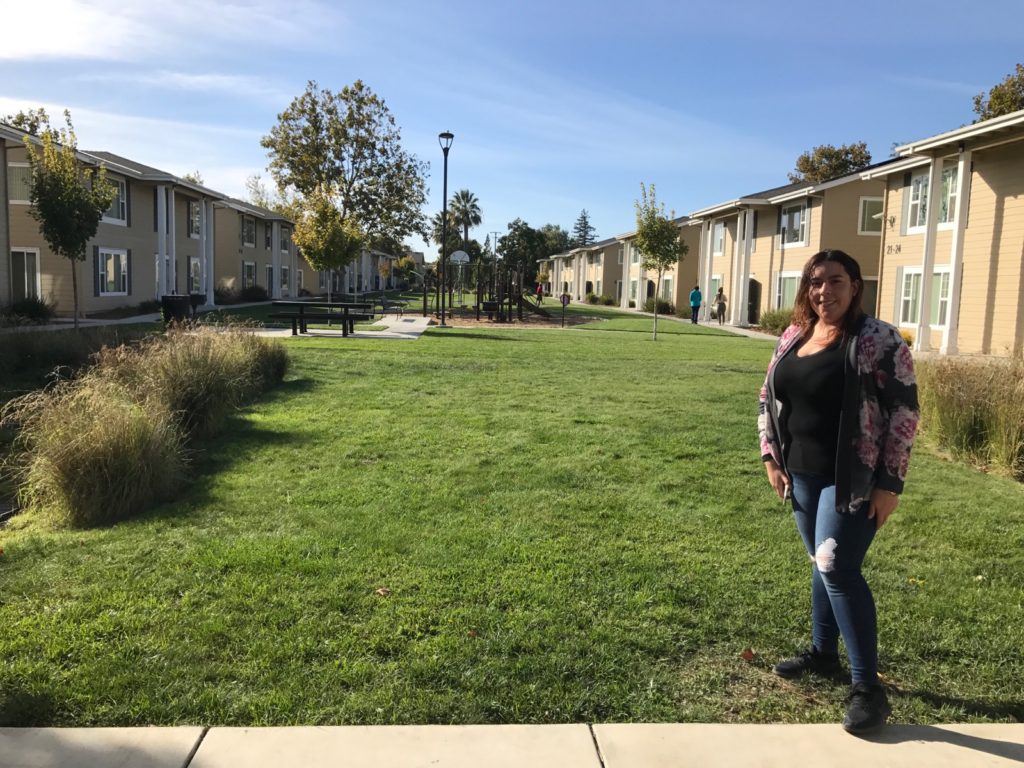
For a lesson in Community Organizing 101, meet Jessica Cuevas.
Not long after she became the organizer at Mutual Housing on the Greenway, Jessica walked into a problem: some of the kids, as kids do and have always done, picked on each other. The maintenance tech at the Greenway saw it, and so did a couple of parents, who brought it to the attention of the staff at the tidy and otherwise friendly affordable housing community in south Sacramento.
Word got to Jessica, and the 24-year-old UC Davis graduate who had been on the job for only a year rolled into facilitation mode.
“Two of our parents asked if we could do a bullying workshop, so I took it from there,” Jessica said, in a conversation late last month in the same Greenway community room where the residents who first identified the problem gathered with staff and the kids themselves in search of its solution. “I just asked our social work intern if there was anything we could do, and they organized the workshop, and we had 15 kids and five parents show up.”
Then came the hard part with the kids: “to get them to admit it,” Jessica said.
With the behavior laid bare, Jessica, some key Greenway staff, the parents, and even some of the young people who had engaged in the tormenting of their peers explored the causes and consequences, and the language, of bullying. “Roasting,” they called it, or just a playful joking around even if it always had to come at somebody else’s expense. As they delved into it, the kids came to realize that what might start out as a laugh can act as a “cover,” as Jessica described it, for deeper, meaner, more complex emotions. “Roasting,” everybody came to understand, was actually “bullying.”
Since that first meeting a few months ago, participants have met for two hours every Wednesday night to talk about bullying and the devastating impact it can have on its targets. The sessions serve as a check-in for the parents to talk to the youth, and not just about bullying, but about everything that is going on in their lives – the stresses and anxieties that they might feel in the course of the day and how they translate into a harshness that they take out on neighbors that should be their friends.
So far, the sessions have not wiped bullying off the face of the Greenway map. And Jessica realizes that “it’s always going to be an issue with kids, just because there are so many factors that are affected,” not the least of which is reluctance of a lot of the kids who might be in the middle of the playground pecking order to tell anybody in authority about the actions of the principal perpetrators and the impact they have on members of their group who are less equipped to stand up to it.
While it may take years before anybody can see the long-term result of the Greenway anti-bullying action plan, the Jessica Cuevas action plan served as a textbook example of effective community organizing. Whether it’s getting people together to attend a City Council or school board meeting, or introducing residents to a computer literacy or environmental leadership program, or solving a social problem in their midst such as bullying, the idea is to everybody together and let them take the initiative to come up with a program that works.
“To me, it’s just a way of enriching the residents’ lives and improving their quality of life,” she said. “I think that’s where Mutual Housing is unique. And in the past few months it has been the residents here at Greenway who have stepped up. It’s not just us bringing them in as partners and coming up with the program. It’s really listening to them and what they know they’re going to use and take advantage of.”
Each of Mutual Housing’s 19 communities has a community organizer like Jessica Cuevas who works fulltime on the premises. Each of the organizers serves as a point person to help the residents achieve what is unique to their neighborhoods. In every instance, the key to the community organizers’ success lies in the strength of their relationship with the residents that they serve.
“The base of any strong community building effort is strong relationships,” said Fernando Cibrian, Mutual Housing’s director of community organizing. “And Jessica has managed to build some very strong ties to community members at Greenway, and she has worked with them to help them build their own stronger ties within the community. People sometimes want to take shortcuts and say, ‘What do you need?’ and ‘Here it is,’ – and that doesn’t build community. What builds community is building relationships, and Jessica is excellent at that.
“Within organizing, we have an iron rule – never do for others what they can do for themselves,” Cibrian added. “It really helps us think about how are we getting our members to build their own power in their community. Certainly, Greenway is a powerful community, looking at the relationships that they are building, internally and externally, and Jessica has played a very important role in that.”
All of the community organizers followed their own path to their Mutual Housing communities, and Jessica’s began in the industrial southeast Los Angeles suburbs of Huntington Park and Maywood where she grew up. When she graduated from high school, Jessica had her choice of several UC and Cal State University campuses to attend. She chose Davis for its unique, college-town feel and her yearning to experience life from some place different from what she had always known.
At UC Davis, Jessica double-majored in Chicano Studies and Community and Regional Development. As a junior, she learned of Mutual Housing through a college project that introduced her to the fledgling Mutual Housing at Spring Lake community in Woodland that was built for area farm workers. Through the college project, she learned of a 2016 summer internship with Mutual Housing, applied for it, and got it. Later in the summer, Mutual Housing hired Jessica as a part-time community organizing assistant. When she graduated in June 2017, she was promoted to fulltime community organizer and assigned to the Greenway.
Jessica quickly learned that the Greenway had already developed a very strong culture that featured what she described as a distinctively “southern” sensibility where all the kids respectfully referred to her as “Miss Jessica.” It was a community with some very powerful voices in residents such as Charlene Jones and Cherrae Rushton who were active within the Greenway and who had established contacts with school, police, and city officials, to make sure their voices were recognized. They told Jessica that they would always be available to help her connect with the community, to make sure that the Mutual Housing programs ran smoothly.
Their relationship has only flourished in the year and a half since.
“Jessica is unbelievably awesome,” said Charlene, who is a member of the Mutual Housing California board of directors. “She’s just very attentive, very kind-hearted. She listens to everything. She deals with conflict extremely well. She’s very thorough in what she does. Her ideas are great. She makes everything perfect. She forgets nothing. She makes sure we’re on time. She is so organized and so efficient in everything that she does.”
Any success she enjoyed at Greenway, Jessica said, resulted from the relationships she built with people in the community such as Charlene and Cherrae.
“It’s how you know you’re doing really great work, when you go into a place and connect with the people and understand them on a deeper level,” Jessica said. “It’s what I always wanted to be doing. I didn’t want to be coming in and disrupting. I wanted to be culturally sensitive, connecting, understanding the residents, so that we see each other as one, not as one is ‘me’ and one is ‘they.’”
Given the already strong leadership that the Greenway residents exerted in their community, Jessica knew she did not have to come in with a heavy hand.
“We don’t think of leaders as being the person who is going to control anything all the time, or be in charge of it,” she said. “I’m just the person they might look to for a little guidance. Here, we know that anyone is capable of anything. With just a little bit of a push, anyone can become a community leader.”
Last month, Jessica learned that she has been accepted into Master’s program for human and social services at the online Walden University. Still, she plans to stay on at Mutual Housing for at least another five years, “just to really build my strong foundation.” Her life plan then calls for Jessica to someday move back to Southern California and to help make some changes in her hometown of Maywood, maybe in the area of public health.
“Because of this work I’m doing for Mutual Housing, and also because of my education, I’ve learned that you do have a voice in what goes on in your community and that there are so many things you can do to change the conditions,” Jessica said. “That’s kind of what I want to do, to go back to my community and really fight there and to do as much as I can to make a change there for the future.”
More than likely, the day will come when Jessica Cuevas does move on from Mutual Housing California and from the Greenway. When it happens, a part of her will remain in the hearts and minds of the residents and staff who worked with her and the young people of today who benefited from the programs she helped to create.
Perhaps none of them will remember her more than the kids now who attend the Wednesday night meetings that have solidified the relationships, with an agenda that goes beyond just the bullying discussions to include time for homework and time to build friendships by playing games and having fun.
To capture the spirit of the program, the group came up with the idea of a “unity plant.” To the casual observer, the plant appears to be nothing more than a simple little fern, decorated with simple little sayings, offered by the kids on simple little things they can do to lessen the anything-but-simple sense of fear and foreboding laid down by an unchecked bully. They talk about helping the victims, informing the adults, standing up to the intimidator.
Eventually, they’ll plant the fern in the ground and as they grow, and as it grows, it will act to remind them of the program that “Miss Jessica” nurtured to give them the opportunity to become the leaders of the future.
“I’m always here for the residents,” Jessica said. “No matter how tough a day gets, no matter how exhausting, I always remind myself of the great relationships I’ve been able to build with everybody.”
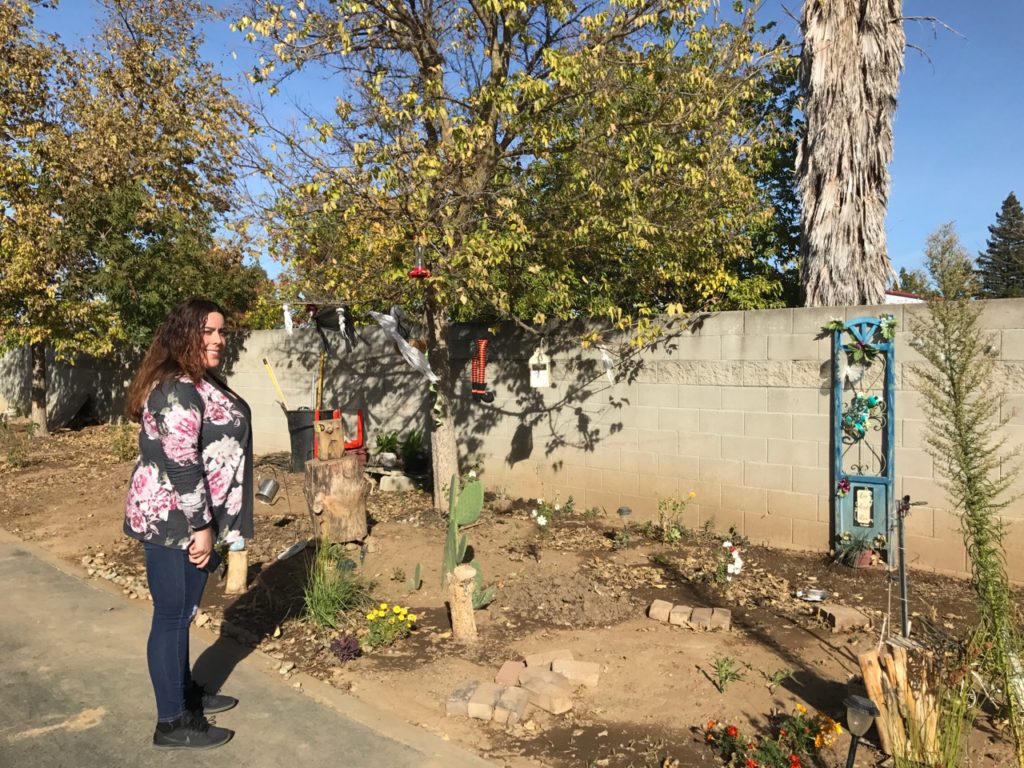 Jessica Cuevas shows the garden where the little fern, planted as a “unity plant”, now grows alongside its community leaders.